TO EXPLORE
MUST-SEE PLACES TO DISCOVER
Portovenere is considered one of the most captivating destinations on the Italian Riviera and the gateway to the Cinque Terre. Although located just a few minutes by boat from the famous five villages, it is less crowded and offers a more exclusive and enjoyable experience in a setting that is more relaxed, elegant and authentic, with easily accessible beaches and more convenient transport connections.
From your doorstep, the very best of Portovenere is within easy walking distance. St. Peter's Church, Doria Castle, Byron's Grotto, the picturesque harbour and colourful waterfront, and the carugio (the village's historic main street): a UNESCO World Heritage Site waiting to be discovered on foot.
And if you're ready to dive into the crystal-clear waters of the Gulf of Poets, discover the area's most beautiful beaches.
Finally, don't forget that Portovenere is also the perfect base for day trips by land or sea and offers a wide range of unforgettable experiences. Make the most of your stay with our recommendations!
WITHIN WALKING DISTANCE

2’ WALK FROM THE APARTMENT
Church of St. Peter
With its iconic black-and-white striped façade perched dramatically on a rocky promontory, the Church of St. Peter is the symbol of Portovenere. Built on the remains of an ancient Roman temple dedicated to Venus, its loggia offers breathtaking views over the Ligurian coastline.

2’ WALK FROM THE APARTMENT
Byron’s Grotto
A striking natural cave located beneath the Church of St. Peter. According to legend, Lord Byron found inspiration here for his poetry and even swam from this point to Lerici to visit the poet Percy Shelley.

4’ WALK FROM THE APARTMENT
Castello Doria
An imposing medieval fortress built by the Republic of Genoa, offering spectacular views over the village, the open sea, and the entire Gulf of Poets.

4’ WALK FROM THE APARTMENT
Church of San Lorenzo
A 13th-century church housing the miraculous parchment icon of the White Madonna, celebrated every year on August 17th during one of Italy’s most evocative traditional festivals.

4’ WALK FROM THE APARTMENT
Medieval entrance
The ancient fortified gateway to Portovenere. Built in 1113, this medieval entrance still leads today into the Carugio and the historic heart of the village. Beside the gateway, the original marble measuring units used centuries ago to calculate taxes on wine and grain, can still be seen.

1’ WALK FROM THE APARTMENT
The Carugio
The vibrant heart of the old village, lined with artisan shops, restaurants, and authentic hidden corners that still preserve the soul of Portovenere.

2’ WALK FROM THE APARTMENT
Calata Doria & The Palazzata
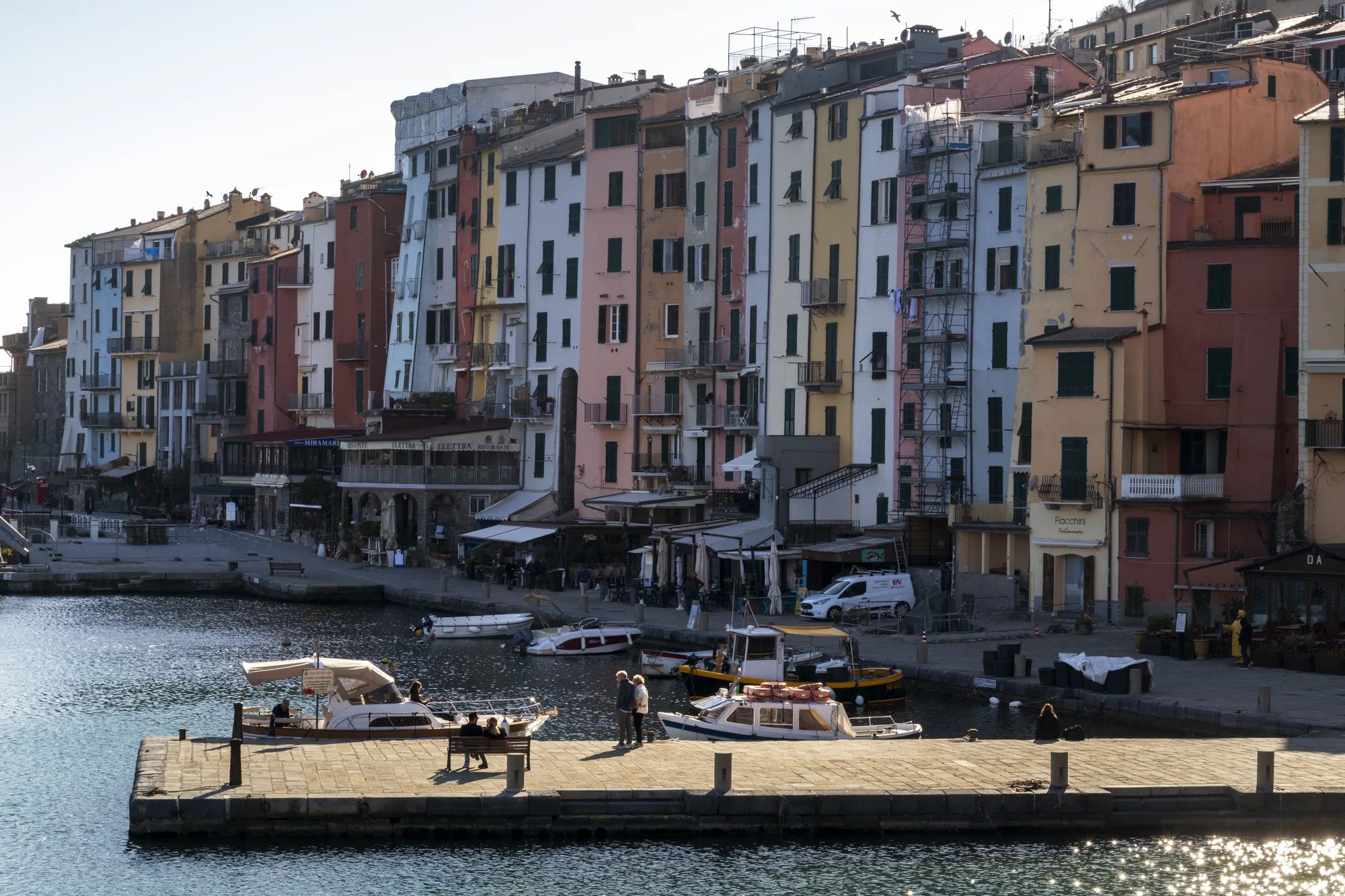
The picturesque waterfront promenade, framed by the village’s iconic row of tall, narrow, colourful houses overlooking the harbour, once part of the town’s ancient defensive system.

WITHIN WALKING DISTANCE
Map
Discover all the places within walking distance from the apartment.
The History of Portovenere
Located at the western tip of the Gulf of La Spezia, Portovenere is home to a rich and fascinating history, where the sea is intertwined even with myth.
The discoveries made by Giovanni Capellini in the nineteenth century reveal a land inhabited since prehistoric times, as evidenced by the remains found in the Grotta dei Colombi (Cave of the Doves) on Palmaria Island.
In pre-Roman times, the promontory was inhabited by the proud Ligurian people before being conquered by the Romans in the 2nd century BC. The very name Portus Veneris dates back to Roman times, when a temple dedicated to Venus was built on the tip of the headland—where St. Peter's Church now stands. According to mythology, Venus, the goddess of love and beauty, was born from the foam of the sea.
Contested over the centuries by the Lombards, Carolingians, Normans and Saracens, the village came under Genoese rule in 1113. The Genoese transformed it into a prosperous and strategically important settlement, giving it the distinctive character it still retains today: the tall, narrow houses lining Via Capellini, the defensive walls and the imposing Doria Castle overlooking the village, all built to make Portovenere a true fortified town.
In the centuries that followed, Portovenere shared the fortunes of the Republic of Genoa, preserving its economic importance thanks to the wines of Palmaria Island and the prized Portoro marble.
During the nineteenth and twentieth centuries, it became a favourite destination for writers and artists. Lord Byron found inspiration in the cave that now bears his name; Percy Bysshe Shelley named the Island of Tino the "Island of the Sirens"; and Eugenio Montale dedicated a poem to Portovenere, portraying it as a place beyond time, where people reconnect with their deepest roots.
Today, as part of the UNESCO World Heritage Site "Portovenere, Cinque Terre and the Islands", the village continues to captivate visitors with its perfect balance of history, culture, nature and the sea.